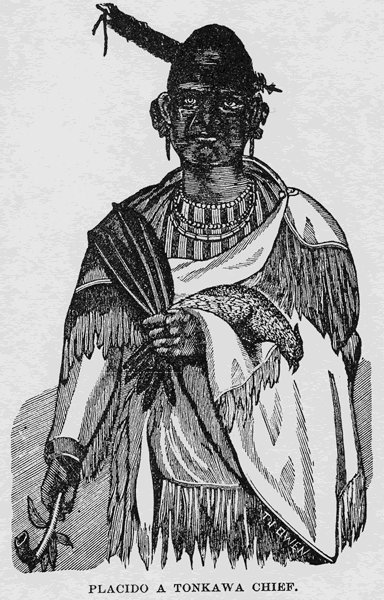
CHIEF PLACIDO (c. 1800–1867)
War Chief of the Tonkawa Nation
Placido was the war chief of the Tonkawa nation — a tribe that had formed a strategic alliance with the Republic of Texas in its conflicts with the Comanche. His presence at Plum Creek, commanding thirteen Tonkawa warriors, is analytically significant for this project’s argument about the colonial production of differential categories of Indigenous peoples within the same space.
The Tonkawa and Comanche were, in the words of the primary sources, “inveterate enemies” (Wilbarger 33), and Placido’s alliance with the Republic was a strategic relationship rooted in this long-standing enmity rather than in any sympathy for the colonial project itself. Yet within the structure of the Battle of Plum Creek, the Tonkawa occupied a particular position: enrolled as Indigenous auxiliaries fighting on behalf of the settler-colonial apparatus against another Indigenous nation. To ensure they would not be mistaken for the enemy, Placido and his warriors tied white rags around their arms before the battle (Brice 83) — an image that encapsulates with painful clarity the differential classification of Indigenous peoples that the colonial structure produced: one group enrolled in the apparatus, another targeted by it, both their fates determined by a territorial logic neither had authored.
Placido’s Tonkawa fought with notable courage at Plum Creek. After the battle, as Wilbarger records, they “busied themselves in fleecing the flesh and cutting off the feet and hands of their inveterate enemies — the Comanches” (Wilbarger 33) — a practice rooted in Tonkawa ritual and the depth of the inter-tribal enmity, but one that Anglo-Texan sources recorded with the same horrified fascination they brought to all expressions of Indigenous life. Placido continued to serve as a scout and auxiliary for Texas Rangers and U.S. Army forces through the 1850s and 1860s. He was killed in 1867 when Confederate-aligned forces massacred the Tonkawa at the Wichita Agency in Oklahoma during the Civil War — a fate that illustrates with terrible precision what settler-colonial enrollment ultimately offers its Indigenous auxiliaries.
Sources:
Brice, The Great Comanche Raid of 1840 (1968), p. 83; Wilbarger, Indian Depredations in Texas (Hutchings, 1889), pp. 29–33; Smithwick, Evolution of a State (Gammel, 1900), p. 250.
 PROJECTPLUM WOKE#