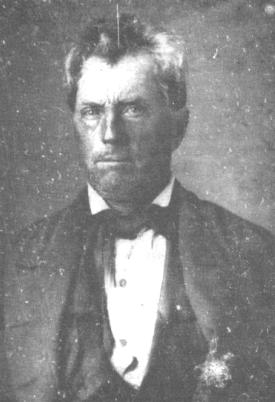
COLONEL EDWARD BURLESON (1798–1851)
Texas Military Commander
Edward Burleson was a Virginia-born soldier who had fought in the Creek War and the War of 1812 before arriving in Texas in 1830. He commanded Texan forces at the siege of Bexar (1835) and fought at San Jacinto. By 1840 he was among the most experienced frontier commanders in the Republic, and it was his force — eighty-seven Anglo-Texan volunteers from the Bastrop area, supplemented by thirteen Tonkawa warriors under Chief Placido — that arrived at Plum Creek in time to participate in the decisive engagement of August 12, 1840.
Burleson’s role at Plum Creek was structurally representative of the rabble-state convergence Wolfe describes. He had ridden up the Colorado River valley to Bastrop, gathering volunteers along the way after receiving Ben McCulloch’s dispatch about the raids on Victoria and Linnville, held a council at Bastrop, and sent a messenger to Austin for reinforcements before riding through the night to reach Good’s Crossing (Brice 65). His force arrived at a gallop for the last three or four miles, the Tonkawa warriors — horseless — running alongside and arriving in time to participate (Brice 66). When Burleson’s men arrived at Plum Creek, a “whispered cheer” arose from the volunteers already gathered (Brice 74). He commanded the right wing of General Huston’s “hollow square” formation, and it was his wing’s coordinated movement around the point of woods — combined with Caldwell’s charge into them — that broke the Comanche formation and began the rout (Brice 78).
Burleson later served as Vice President of the Republic of Texas under Anson Jones (1844–1845) and as a Texas state senator after annexation. He died in Austin in 1851.
Sources
Brice, The Great Comanche Raid of 1840 (1968), pp. 65–66, 74–78; Wilbarger, Indian Depredations in Texas (Hutchings, 1889); Smithwick, Evolution of a State (Gammel, 1900).
 PROJECTPLUM WOKE#