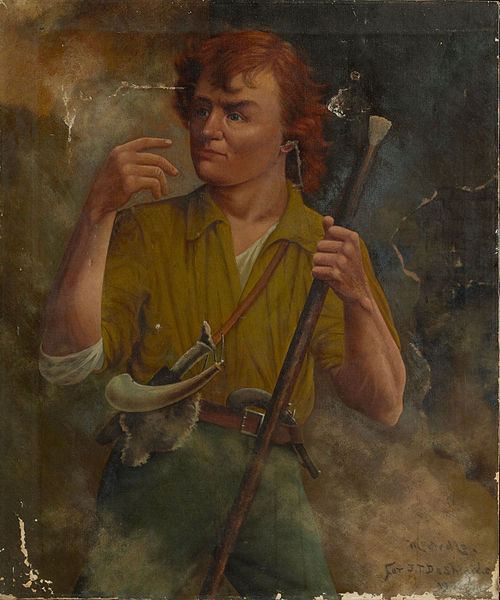
COLONEL HENRY W. KARNES (1812–1840)
Texas Military Commander and Indian Commissioner
Henry W. Karnes was a Kentucky-born soldier who served with distinction in the Texas Revolution and became one of the Republic’s most important frontier military commanders and Indian affairs intermediaries. He appears at pivotal moments in this history as both the Republic’s principal diplomatic contact with the Comanche and the officer whose decisions set in motion the events leading to the Council House Fight.
In March 1838, Karnes traveled to San Antonio to meet Comanche representatives — reporting to Secretary of State R. A. Irion that the Comanche had “made a positive declaration as regards their territorial limits” and had resolved “to kill all the surveyors found within the territory which they consider theirs” (Texas Indian Papers, 1825–1843 43). His report identifies the fundamental structural problem the Republic faced: the Comanche were aware that the object of Texan expansion was to “acquire our lands unjustly,” as Mexican agents at Matamoros had told them (Texas Indian Papers, 1825–1843 43) — and they were correct. Karnes negotiated the preliminary arrangements that led to the 1838 Comanche treaty and continued as the Republic’s primary contact with the Comanche through 1840.
It was Karnes who, in January 1840, received the three Comanche chiefs who arrived in San Antonio to discuss peace following the smallpox epidemic — and who refused negotiations “without the release of the American Captives, and the restoration of all stolen property; besides giving guarantees that future depredators on our property should be delivered up for punishment” (Karnes, qtd. in Brice 35). The chiefs, informing Karnes that their council had agreed to these terms eighteen days earlier, promised to return with captives and additional chiefs. The Secretary of War’s subsequent instruction to Colonel Fisher — to seize the Comanche delegates as hostages if captives were not produced — set the trap that the Council House Fight would spring. Karnes died of yellow fever in August 1840, just months after the Council House Fight, and did not live to see the events his diplomatic and military career had helped set in motion reach their culmination at Plum Creek.
Sources
Texas Indian Papers, 1825–1843, ed. Pickrell and Temple (Texas State Library, 1959), pp. 42–45; Brice, The Great Comanche Raid of 1840 (1968), pp. 34–36.
 PROJECTPLUM WOKE#