Postcolonial Glossary: Structuring Local Texas History in Global Critique
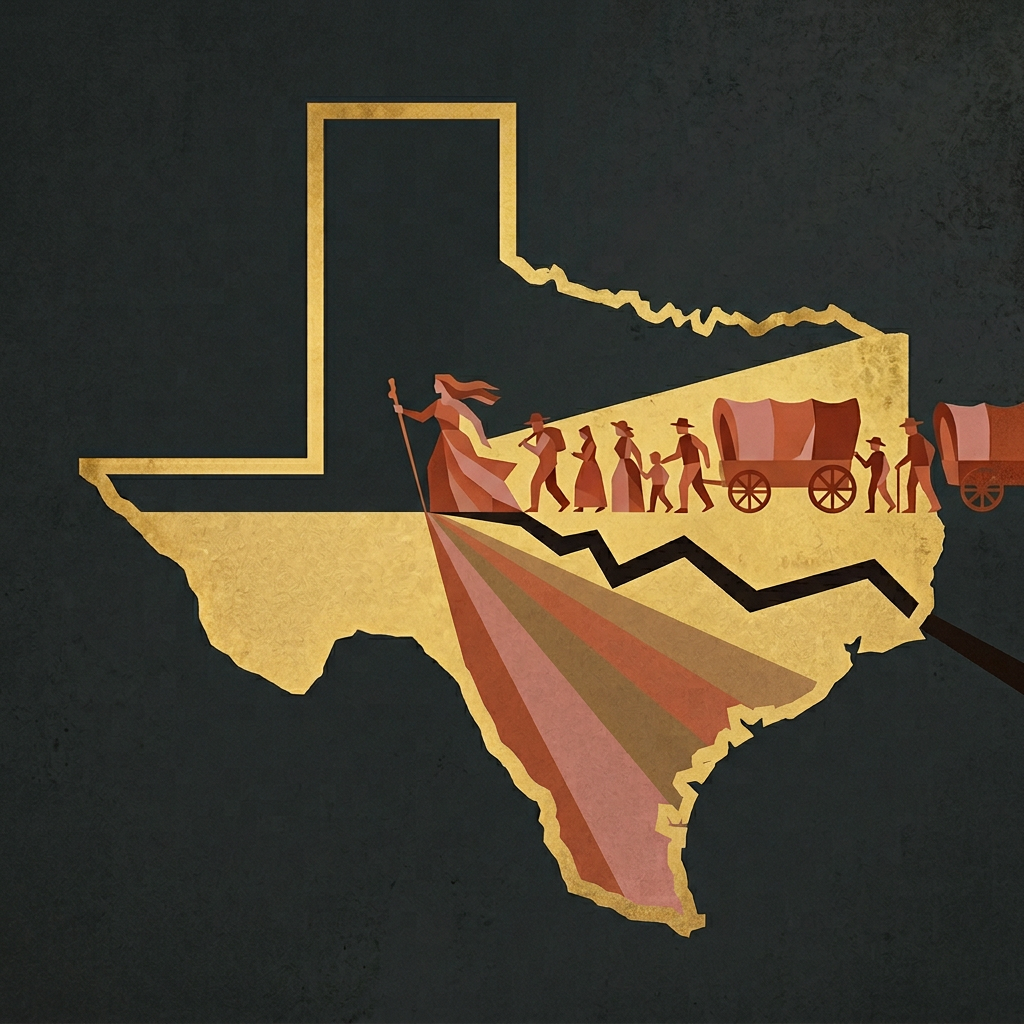
AMERICAN EXCEPTIONALISM ★
(noun phrase | political ideology | American origin, 19th–20th c.)
As a narrative framework, American exceptionalism functions to make US territorial expansion appear natural, inevitable, and just — foreclosing critical analysis of the violence and dispossession on which that expansion rested. In the context of Texas history, it is the story that turns the systematic elimination of Comanche sovereignty into a story of civilization, progress, and destiny. It is not a description of history. It is a management of it.
Use in this exhibition
American exceptionalism is the myth — in Claude Lévi-Strauss’s precise sense — that Texas and the United States produced to manage the foundational contradiction between their proclaimed values of liberty and equality and the reality of Indigenous elimination on which those values were built. See: Myth (Lévi-Strauss).
Further Reading
Pease, Donald E. The New American Exceptionalism. University of Minnesota Press, 2009. Wolfe, Patrick. “Settler Colonialism and the Elimination of the Native.” Journal of Genocide Research, vol. 8, no. 4, 2006, pp. 387–409. Hämäläinen, Pekka. The Comanche Empire. Yale University Press, 2008.
COLONIAL SPACE
(noun phrase | critical geography | origin: Mbembe / Saldaña-Portillo)
The organized production of a new social and spatial order written onto a physical geography through the drawing of new boundaries, the classification of people into legal categories, and the manufacture of stories that justify differential rights.
Use in Exhibition:
Colonial space is not simply territory that colonizers occupy. It is territory that colonizers actively produce — rewriting its boundaries, its property arrangements, its human classifications, and its cultural meaning. In Texas between 1836 and 1845, colonial space was produced through land acts, bounty grants, colonization contracts, military campaigns, and treaty-making — all working simultaneously to write a new social order onto a landscape that already belonged to someone else. The Republic did not find Texas empty. It made Texas empty, on paper, before it could make it empty on the ground.
Further Reading:
Saldaña-Portillo, María Josefina. Indian Given: Racial Geographies Across Mexico and the United States. Duke University Press, 2016. Mbembe, Achille. On the Postcolony. University of California Press, 2001. McKitrick, Reuben. The Public Land System of Texas, 1823–1910. University of North Texas Libraries, The Portal to Texas History, 1918. texashistory.unt.edu/ark:/67531/metapth29759/.
CULTURAL IMAGINARY
(noun phrase | cultural theory | origin: social theory, 20th c.)
The shared set of stories, images, symbols, and beliefs that a society produces to give meaning to its power arrangements — making those arrangements appear natural, inevitable, and just.
Use in Exhibition:
The cultural imaginary of Texas is not a neutral description of history. It is a manufactured legitimation of the colonial process that produced Texas as a geopolitical space. The Alamo, the Texas Ranger, the frontier hero, the civilizing mission — these are not memories of what happened. They are the stories the replacement society produced to make its own origins appear heroic rather than structural. The cultural imaginary is the final instrument of settler colonialism: the production of meaning that renders dispossession invisible long after the frontier has closed.
Further Reading:
Saldaña-Portillo, María Josefina. Indian Given: Racial Geographies Across Mexico and the United States. Duke University Press, 2016. Wilbarger, J. W. Indian Depredations in Texas. Hutchings Printing House, 1889. Smithwick, Noah. Evolution of a State, or, Recollections of Old Texas Days. Gammel Book Company, 1900.
DIFFERENTIAL RIGHTS
(noun phrase | legal theory / colonial studies)
The allocation of unequal legal entitlements to different categories of people within the same geographic space — typically organized by race, citizenship status, or colonial classification.
Use in Exhibition:
In the Republic of Texas, differential rights were not a flaw in the legal system. They were its organizing principle. The 1836 Constitution explicitly granted land rights — one league and labor (4,605 acres) per family head — to white male citizens, while expressly excluding “Africans, the descendants of Africans, and Indians” from citizenship and land entitlement entirely. Differential rights were produced simultaneously with the production of colonial space: the same act that confirmed settler entitlement erased Indigenous territorial sovereignty. The two operations were not separate. They were the same operation, performed on different categories of people in the same legal document.
Further Reading
Saldaña-Portillo, María Josefina. Indian Given: Racial Geographies Across Mexico and the United States. Duke University Press, 2016. McKitrick, Reuben. The Public Land System of Texas, 1823–1910. University of North Texas Libraries, 1918. texashistory.unt.edu/ark:/67531/metapth29759/. Wolfe, Patrick. “Settler Colonialism and the Elimination of the Native.” Journal of Genocide Research, vol. 8, no. 4, 2006, pp. 387–409.
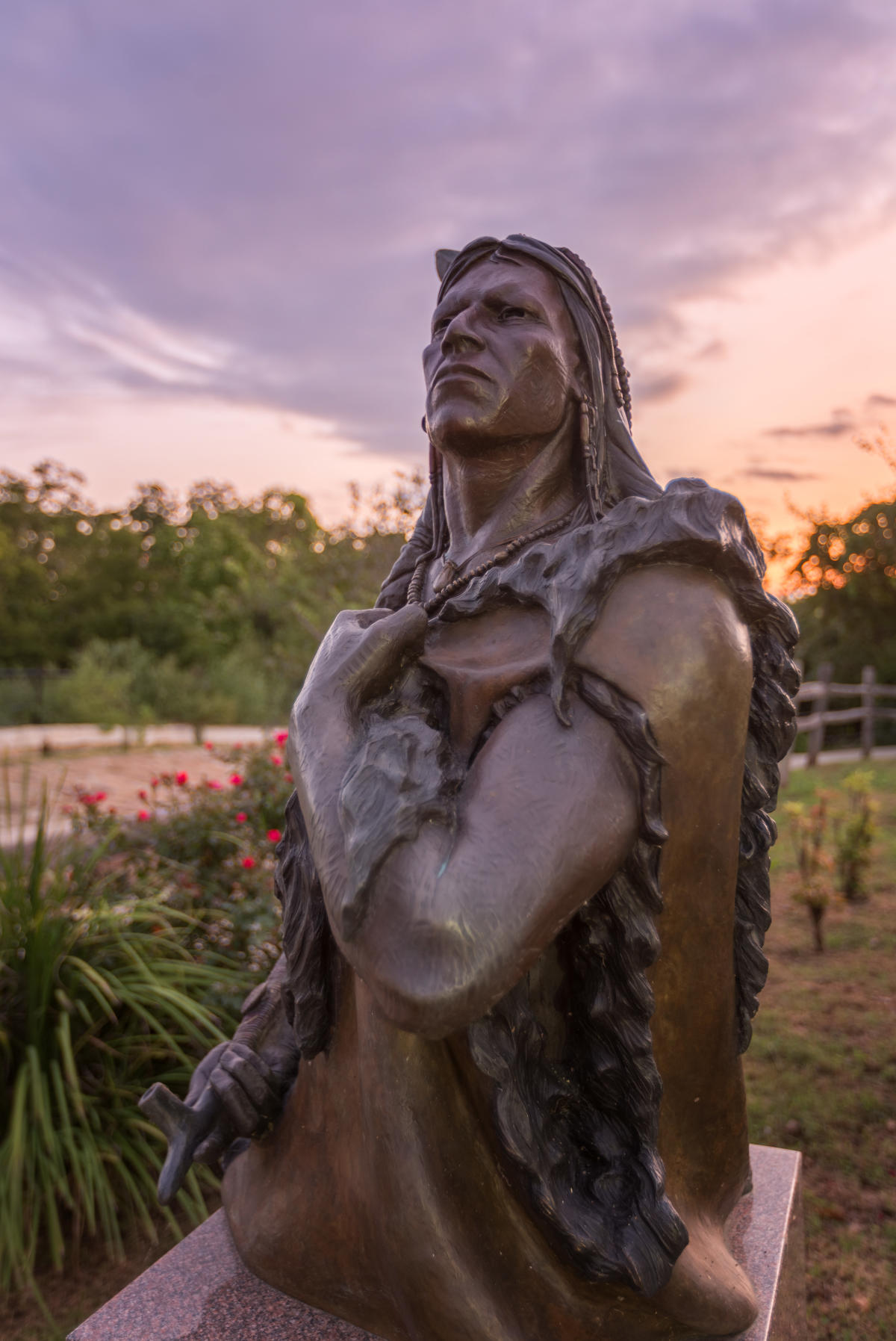
ENROLLED AUXILIARIES
(noun phrase | settler colonial studies | this exhibition)
Indigenous peoples incorporated into the settler-colonial military apparatus — fighting on behalf of the settler state against other Indigenous peoples, typically in exchange for protection, alliance, or survival.
Use in Exhibition:
At the Battle of Plum Creek on August 12, 1840, Chief Placido’s thirteen Tonkawa warriors fought alongside Anglo-Texan militia and Texas Militia against the Comanche. They tied white rags to their arms so the Texans would not shoot them. This image — the enrolled auxiliary marked for recognition by the colonial apparatus he was fighting for — encapsulates the differential classification of Indigenous peoples that settler colonialism produces: one group enrolled in the structure, another targeted by it, both their fates determined by a territorial logic neither had authored. The Tonkawa’s own sovereignty remained unclaimed and unrecognized by the Republic they fought beside. Placido was killed in 1867 when Confederate-aligned forces massacred the Tonkawa in Oklahoma — the typical fate of the enrolled auxiliary when their usefulness ends.
Further reading:
Brice, Donaly E. The Great Comanche Raid of 1840. Redacted thesis, 1968. Hämäläinen, Pekka. The Comanche Empire. Yale University Press, 2008. Wolfe, Patrick. “Settler Colonialism and the Elimination of the Native.” Journal of Genocide Research, vol. 8, no. 4, 2006, pp. 387–409.
LOGIC OF ELIMINATION
(noun phrase | settler colonial theory | origin: Patrick Wolfe, 2006)
The organizing principle of settler colonialism: the structural drive to permanently remove Indigenous peoples from their land in order to replace them with a settler society — operating not through a single method but through whatever combination of legal, military, demographic, and diplomatic instruments the situation allows.
Use in Exhibition:
The logic of elimination is not a plan. It is a structure. It does not require a conspiracy or a conscious decision to eliminate — it requires only that the territorial imperative (the land) remain constant, and that every available instrument be aligned toward serving it. In Texas between 1836 and 1845, the logic of elimination expressed itself simultaneously through constitutional exclusions, bounty land grants, colonization contracts, military campaigns, and diplomatic treaties — each instrument different in form, identical in structural function. Most importantly, Wolfe insists: race is made in the targeting, not prior to it. The Comanche were not eliminated because they were savage. They were declared savage because they occupied land the Republic of Texas required.
Further reading:
Wolfe, Patrick. “Settler Colonialism and the Elimination of the Native.” Journal of Genocide Research, vol. 8, no. 4, 2006, pp. 387–409. Hämäläinen, Pekka. The Comanche Empire. Yale University Press, 2008. Saldaña-Portillo, María Josefina. Indian Given: Racial Geographies Across Mexico and the United States. Duke University Press, 2016.
MYTH
(Lévi-Strauss) (noun | structural anthropology | origin: Claude Lévi-Strauss, 1963)
A narrative structure that a society produces not to describe reality accurately, but to manage an irresolvable contradiction within it — making livable what cannot otherwise be reconciled.
Use in Exhibition:
For Claude Lévi-Strauss, myth is not simply a false story. It is a cognitive and cultural technology: a narrative that takes a real, foundational contradiction in a society’s self-understanding and resolves it — not by solving the contradiction but by telling a story in which it disappears. American exceptionalism is the myth that the United States and Texas produced to manage their foundational contradiction: a political culture built on the proclaimed values of liberty, equality, and republican self-governance, erected on the systematic elimination of the peoples whose land made those values possible. The myth resolves the contradiction by declaring Indigenous peoples savage — outside the moral community to which liberty applies. The violence of dispossession becomes the advance of civilization. The structure becomes destiny.
Further reading:
Lévi-Strauss, Claude. Structural Anthropology. Basic Books, 1963. Pease, Donald E. The New American Exceptionalism. University of Minnesota Press, 2009. Saldaña-Portillo, María Josefina. Indian Given: Racial Geographies Across Mexico and the United States. Duke University Press, 2016.
NEGATIVE DIMENSION OF ELIMINATION
(noun phrase | settler colonial theory | origin: Patrick Wolfe, 2006)
The destructive face of the logic of elimination: the active dissolution of Indigenous societies — their governance structures, territorial arrangements, political authority, and collective life — in order to clear the ground for settler occupation.
Use in Exhibition:
The negative dimension of elimination is not simply killing. It is the targeted destruction of what makes a society a society: its leadership, its institutions, its capacity to assert and defend territorial sovereignty. The Council House Fight of March 19, 1840 is the clearest instance of the negative dimension in this exhibition’s archive. What was killed on that day was not just twelve individuals — it was the political leadership of the eastern Comanche bands, the chiefs who held the authority to negotiate, conclude treaties, and bind the nation to diplomatic agreements. The Republic destroyed not bodies alone but governance structures — the Comanche’s capacity to assert sovereignty through its normal political channels. The negative dimension always operates alongside the positive dimension: while one hand destroys the Indigenous society, the other builds the replacement.
Further reading:
Wolfe, Patrick. “Settler Colonialism and the Elimination of the Native.” Journal of Genocide Research, vol. 8, no. 4, 2006, pp. 387–409. Brice, Donaly E. The Great Comanche Raid of 1840. Redacted thesis, 1968. Hämäläinen, Pekka. The Comanche Empire. Yale University Press, 2008.
PALIMPSEST ★
(noun | from Latin palimpsestus, from Greek palimpsēstos: “scraped again” | literary / geographic theory)
A surface — originally a manuscript — that has been written over multiple times, with earlier inscriptions not fully erased but remaining visible beneath the newer text. Used in geography and history to describe landscapes layered with successive social and spatial orders, each one carrying the traces of what came before.
Use in Exhibition:
Texas is a palimpsest. The county lines follow survey boundaries drawn on Comanche territory in the 1840s. The patterns of land ownership reflect the differential entitlements written into the Republic’s 1836 Constitution. The spatial distribution of wealth and poverty in Texas cities bears the imprint of the racial geographies produced by a century of policies descended from the colonial period. The cultural imaginary — the Alamo, the Ranger, the frontier hero — organizes what is remembered and what is suppressed in a state whose founding story is liberty and whose founding structure was elimination. None of these are natural features of the landscape. They are historical inscriptions — each written over the one before, none fully erasing what lies beneath. To read Texas as a palimpsest is to begin to see what the later inscriptions have covered but not destroyed.
Further reading:
Saldaña-Portillo, María Josefina. Indian Given: Racial Geographies Across Mexico and the United States. Duke University Press, 2016. Hämäläinen, Pekka. The Comanche Empire. Yale University Press, 2008. McKitrick, Reuben. The Public Land System of Texas, 1823–1910. University of North Texas Libraries, 1918.

POSITIVE DIMENSION OF ELIMINATION
(noun phrase | settler colonial theory | origin: Patrick Wolfe, 2006)
The constructive face of the logic of elimination: the simultaneous erection of a replacement society on the expropriated land base — through immigration, colonization, legal institutions, and cultural production.
Use in Exhibition:
The logic of elimination operates on two fronts simultaneously. While the negative dimension destroys Indigenous societies, the positive dimension builds the replacement: importing settlers, issuing land grants, constructing legal institutions, manufacturing a cultural imaginary. In Texas between 1836 and 1845, the positive dimension is visible in the corporate colonization system — the Peters Colony, Castro’s Colony, the Fisher-Miller grant, and the Mercer Colony — which planted English, French, German, and Anglo-American settler populations inside Comancheria under corporate land grant contracts. The structure was indifferent to settler ethnicity. What mattered was not where the settlers came from but what role they performed: the physical occupation and permanent transformation of territory claimed from Indigenous peoples.
Further reading:
Wolfe, Patrick. “Settler Colonialism and the Elimination of the Native.” Journal of Genocide Research, vol. 8, no. 4, 2006, pp. 387–409. Texas General Land Office. Texas General Land Office Colonization Certificate Records, 1848–1855. Texas State Library and Archives Commission. txarchives.org/tslac/finding_aids/40132.xml. McKitrick, Reuben. The Public Land System of Texas, 1823–1910. University of North Texas Libraries, 1918.
RABBLE-STATE CONVERGENCE
(noun phrase | settler colonial theory | origin: Patrick Wolfe, 2006)
The characteristic mechanism of settler-colonial territorial expansion: irregular settlers, land speculators, militia, and the formal state apparatus operating in aligned tandem — each layer enabling and legitimizing the others — so that individual land hunger and state territorial policy become structurally indistinguishable.
Use in Exhibition:
In Texas between 1836 and 1845, the rabble-state convergence was institutionalized through the bounty land grant system: soldiers received 160 acres for a three-year frontier enlistment. The man who fought for the frontier had a personal financial stake in how far it moved — and when his service ended, he stayed on it as a settler. Individual land hunger and state territorial policy were not merely aligned; they were made structurally identical. The state did not simply authorize frontier violence. It structured the incentives that produced it, then regularized its outcomes. When Sam Houston warned Congress in his 1837 veto message that the land system was generating speculative fraud on a massive scale, Congress passed it over his veto. The structure was more powerful than any single objection to it.
Further reading:
Wolfe, Patrick. “Settler Colonialism and the Elimination of the Native.” Journal of Genocide Research, vol. 8, no. 4, 2006, pp. 387–409. Miller, Thomas L. “Texas Bounty Land Grants, 1835–1888.” The Southwestern Historical Quarterly, vol. 66, no. 2, 1962, pp. 221–33. Houston, Sam. Veto Message, June 8, 1837. Writings of Sam Houston, Vol. 2, pp. 118–121.
RACIAL GEOGRAPHY
(noun phrase | critical geography | origin: Saldaña-Portillo, 2016)
The writing of racial categories onto physical space — the production of landscapes that encode and reproduce differential rights, differential belonging, and differential humanity through their boundaries, property arrangements, and cultural meanings.
Use in Exhibition:
Racial geography is the long-run consequence of the logic of elimination: once race is made in the targeting, it does not stay in the bodies of those targeted. It gets written into the landscape — into property lines, spatial hierarchies, neighborhood boundaries, patterns of wealth and poverty — and persists there long after the frontier has closed. The geopolitical space of Texas is a racial geography. Its county lines follow survey boundaries drawn on Comanche territory. Its land ownership patterns reflect the differential entitlements of the 1836 Constitution. Its cultural imaginary organizes who belongs where in a state whose founding classification system declared Indigenous peoples legally invisible and settler citizens constitutionally entitled. Racial geography is not the past. It is the ground beneath our feet.
Further reading:
Saldaña-Portillo, María Josefina. Indian Given: Racial Geographies Across Mexico and the United States. Duke University Press, 2016.
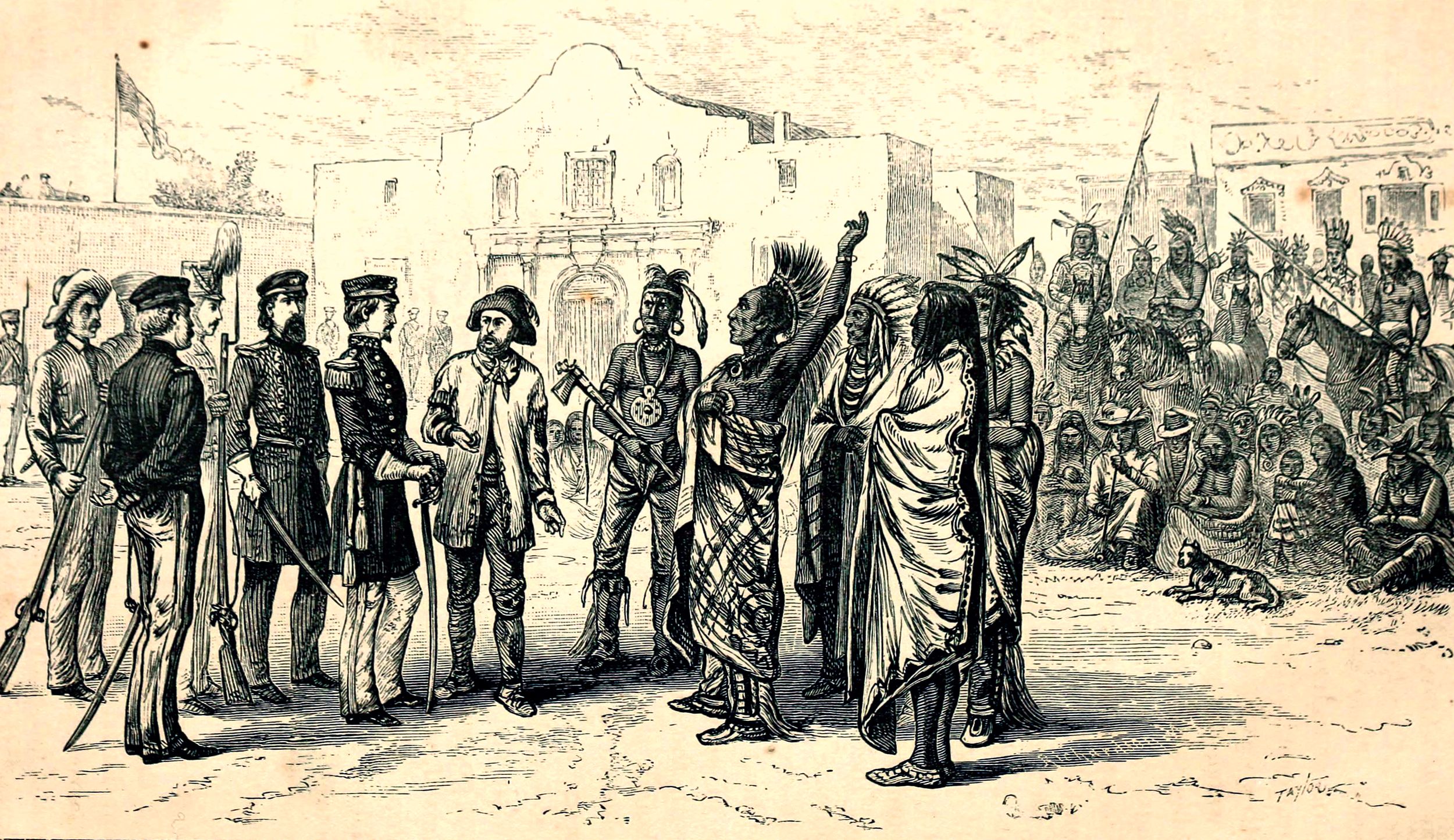
SETTLER COLONIALISM
(noun phrase | colonial / postcolonial studies | origin: 20th–21st c. critical theory)
A form of colonialism distinguished by its goal of permanent settlement and territorial replacement — not the exploitation of Indigenous labor or resources, but the acquisition of the land itself, requiring the removal, by whatever means, of the peoples who already inhabit it.
Use in Exhibition:
Settler colonialism differs from other forms of colonial rule in its irreducible territorial logic: the settler comes to stay. This means the Indigenous peoples already there cannot simply be exploited — they must be removed. Patrick Wolfe’s foundational insight is that this removal does not require a single violent act or a conscious plan of elimination. It requires only that the territorial imperative remain constant and that every available instrument — law, military force, immigration, assimilation, treaty — be aligned toward serving it. Settler colonialism is therefore a structure, not an event. It does not begin and end with a battle, a treaty, or the closing of a “frontier.” It persists in the property arrangements, legal institutions, and cultural imaginaries that the replacement society produces — long after the last campaign has ended.
Further reading:
Wolfe, Patrick. “Settler Colonialism and the Elimination of the Native.” Journal of Genocide Research, vol. 8, no. 4, 2006, pp. 387–409. Hämäläinen, Pekka. The Comanche Empire. Yale University Press, 2008. Saldaña-Portillo, María Josefina. Indian Given: Racial Geographies Across Mexico and the United States. Duke University Press, 2016. Foucault, Michel. “What Is Enlightenment?” The Foucault Reader, edited by Paul Rabinow, Pantheon Books, 1984, pp. 32–50.
Services
SPECTRUM OF ELIMINATION STRATEGIES
(noun phrase | settler colonial theory | origin: Patrick Wolfe, 2006)
The full range of methods through which the logic of elimination operates — from direct violence to legal dispossession, forced removal, assimilation, and demographic replacement — understood not as separate policies but as interchangeable instruments of the same underlying territorial drive.
Use in Exhibition:
One of the most important implications of Wolfe’s framework is that the spectrum of elimination strategies cannot be ranked by moral severity or historical significance. A land grant act and a military massacre are not opposites — one gentle, one violent. They are instruments of the same structure, operating in different registers. Between 1836 and 1845, the Republic of Texas deployed the full spectrum simultaneously: constitutional legal exclusion (1836), military bounty grants (1837–1838), declared extermination policy (1838), military campaigns (1838–1840), corporate colonization contracts (1841–1845), and diplomatic treaties that performed recognition while denying sovereignty (1838, 1844). Each instrument enabled the next. The structure operated through all of them at once.
Further reading:
Wolfe, Patrick. “Settler Colonialism and the Elimination of the Native.” Journal of Genocide Research, vol. 8, no. 4, 2006, pp. 387–409. Brice, Donaly E. The Great Comanche Raid of 1840. Redacted thesis, 1968. McKitrick, Reuben. The Public Land System of Texas, 1823–1910. University of North Texas Libraries, 1918.
STRUCTURAL GENOCIDE
(noun phrase | settler colonial / genocide studies | origin: Patrick Wolfe, 2006)
The sustained, institutionalized, long-run destruction of Indigenous peoples as peoples — without requiring a singular mass killing event, and without requiring comparison to the Holocaust as a definitional standard.
Use in Exhibition:
Wolfe proposed “structural genocide” as a more precise alternative to “cultural genocide” — a term that had come to imply the destruction of culture rather than of peoples, and that tended to minimize the severity of settler-colonial elimination by contrast with the Nazi genocide. Structural genocide captures something that event-based models of genocide miss: that the destruction of Indigenous peoples does not require a single catastrophic moment. It accumulates across decades of legal dispossession, forced removal, demographic replacement, and cultural suppression — none of which, taken alone, necessarily meets a narrow legal definition of genocide, but all of which, taken structurally, produce the same outcome: the dissolution of Indigenous peoples as peoples, with permanent loss of territory, sovereignty, and collective life. The Republic of Texas did not commit a single genocidal event. It built a structure of genocide — and that structure is what this exhibition documents.
in Exhibition:
Further reading
Wolfe, Patrick. “Settler Colonialism and the Elimination of the Native.” Journal of Genocide Research, vol. 8, no. 4, 2006, pp. 387–409.
TERRITORIAL WRITING ACT
(noun phrase | this exhibition’s term | coined for Invasion as Structure)
A military, legal, or diplomatic act whose primary function is the consummation of territorial sovereignty — translating a theoretical claim to land into practical possession on the ground.
Use in Exhibition:
This exhibition coins the term “territorial writing act” to describe the specific moment when a settler-colonial structure’s paper claim to territory becomes physical reality. The Battle of Plum Creek on August 12, 1840 is this exhibition’s primary example. Since 1836, the Republic of Texas had claimed legal sovereignty over central Texas on paper — through constitutional provisions, land grants, and bounty warrants. But Comancheria remained physically beyond the Republic’s control. Plum Creek changed that: after the battle and the subsequent Moore expedition, “most Comanches had retreated north, leaving thousands of square miles open for settlers from Texas” (Hämäläinen 216). The gap between paper sovereignty and physical possession — open since 1836 — began, at Plum Creek, to close. The territorial writing act is the moment the map becomes the territory.
Further reading:
Hämäläinen, Pekka. The Comanche Empire. Yale University Press, 2008. Brice, Donaly E. The Great Comanche Raid of 1840. Redacted thesis, 1968. Wolfe, Patrick. “Settler Colonialism and the Elimination of the Native.” Journal of Genocide Research, vol. 8, no. 4, 2006, pp. 387–409.
 PROJECTPLUM WOKE#