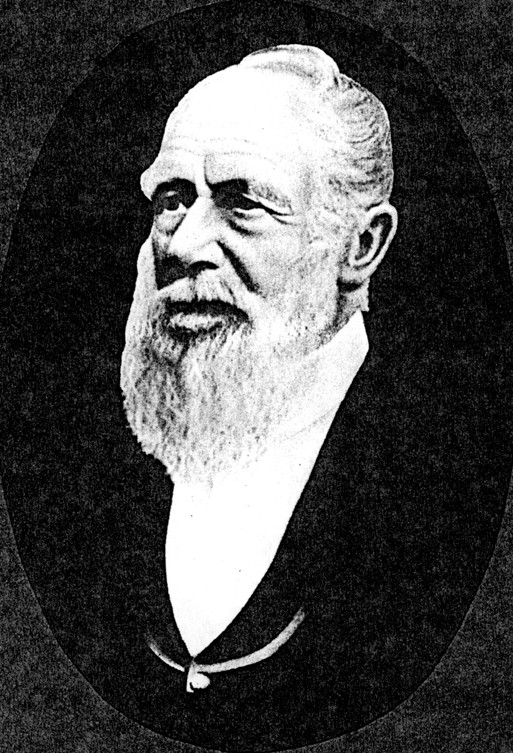
JOHN O. MEUSEBACH (1812–1897)
Commissioner-General, German Emigration Company (Adelsverein)
Johann Friedrich Ernst von Meusebach — who renounced his German baronial title upon emigrating to Texas and became John O. Meusebach — served as Commissioner-General of the Adelsverein (Society for the Protection of German Immigrants in Texas) from April 1845, succeeding Prince Carl of Solms-Braunfels. He founded Fredericksburg in 1846 and negotiated the Meusebach-Comanche Treaty of 1847 with the Penateka Comanche — the agreement that opened the Fisher-Miller Land Grant area to German settlement.
Meusebach’s role in this history is complex and illustrates what this project terms the structural indifference of settler colonialism to the ethnic or national origin of the settler. The Adelsverein was founded by forty German noblemen with the stated philanthropic goal of creating a German cultural colony in Texas that would preserve German values and traditions outside of Europe. In practice, the Fisher-Miller Colony grant it purchased encompassed present-day Concho, McCulloch, San Saba, Menard, Mason, Llano, and Kimble Counties — territory whose boundaries, as the archival record states with geographical precision, “existed deep into Comanche territory” in the 1840s and 1850s (Texas General Land Office Colonization Certificate Records). When Fisher and Miller sold the grant to the Adelsverein in June 1844, they were, according to the Adelsverein’s Wikipedia entry, “aware of the dangers of settling in Comancheria, but did not inform the Verein.”
Meusebach negotiated the 1847 treaty with Penateka Comanche leaders in what is often celebrated in Texas public memory as a rare example of peaceful coexistence between settlers and Indigenous peoples. Read through this project’s analytical framework, however, the Meusebach-Comanche Treaty is the structure operating through its diplomatic instrument: it secured safe passage and land access for German settlers within the grant area, opening Comanche territory to colonization under the form of mutual agreement. The treaty’s structural function was identical to that of every other instrument the Republic and its successor state negotiated: the ratification of a territorial claim already made on paper, through the mechanism of apparent consent. Meusebach later served as a Texas state senator (1851–1853) and died in Loyal Valley, Texas, in 1897.
Sources:
Texas General Land Office Colonization Certificate Records, txarchives.org/tslac/finding_aids/40132.xml; Fisher-Miller Land Grant, Handbook of Texas Online; Adelsverein, Wikipedia; Hämäläinen, The Comanche Empire (Yale UP, 2008).
 PROJECTPLUM WOKE#