Mercer Colony Contract (Colonial Land Grant Agreement)
-
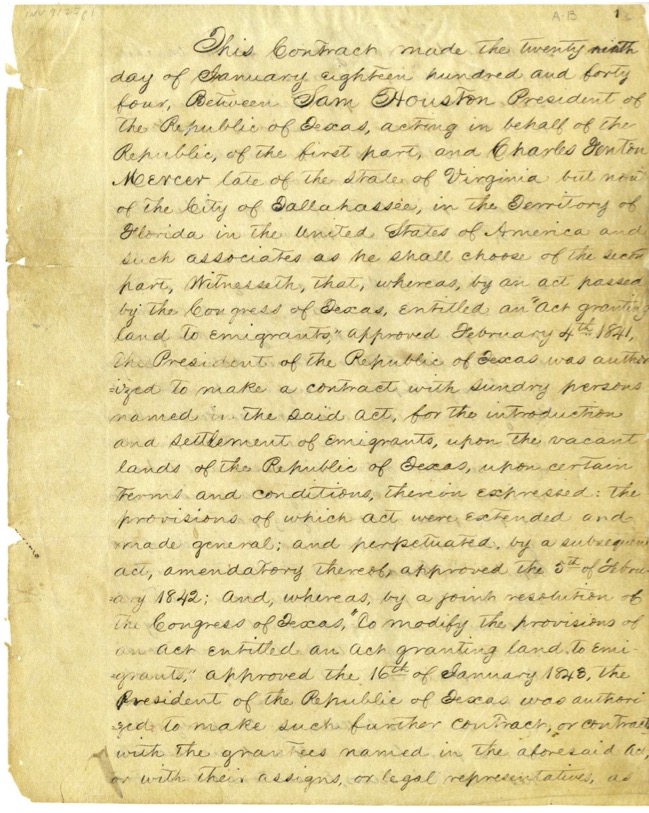
Republic of Texas and Charles Fenton Mercer
January 24, 1844
In 1844, the Republic of Texas entered into a contract with Charles Fenton Mercer to establish what became known as the Mercer Colony. Under the terms of the agreement, Mercer was authorized to recruit settlers—primarily from the United States—and allocate land grants within a vast designated region of North Texas.
Like other empresario and colonization contracts of the period, the Mercer agreement functioned as both policy and speculation. The Republic delegated the work of settlement to private agents, effectively outsourcing expansion. In return, empresarios received rights to distribute land that was often not yet securely controlled by the state. The contract thus transformed territory into a commodity: surveyed, promised, and sold ahead of occupation.
The Mercer Colony was located in a region that overlapped with Comanche territory, revealing the structural tension at the heart of the Republic’s expansion. While the contract framed the land as available for settlement, Indigenous presence remained active and decisive. The result was not immediate colonization but a prolonged and often unsuccessful attempt to impose a system of property over contested ground.
This document illustrates how colonial land grants operated as instruments of state-building. Through legal agreements, the Republic projected authority into regions beyond its effective reach, encouraging migration, investment, and eventual military enforcement. The Mercer contract, like others of its kind, shows how expansion proceeded not only through conflict, but through paperwork—contracts that imagined a future geography before it existed.
Source
Charles Fenton Mercer. Mercer Colony Contract. January 24, 1844. Republic of Texas land grant records.
Texas State Library and Archives Commission, Archives and Information Services Division, Austin, TX.
 PROJECTPLUM WOKE#