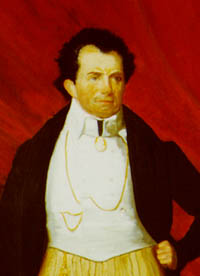
MIRABEAU B. LAMAR (1798–1859)
President of the Republic of Texas (1838–1841)
Mirabeau Buonaparte Lamar was born in Georgia and came to Texas in 1835, serving with distinction at the Battle of San Jacinto. He was elected Vice President under Houston and became President of the Republic in December 1838. His presidency represents the moment at which the logic of elimination — which had operated structurally through legal and demographic instruments under Houston — declared itself as explicit state policy.
Lamar’s inaugural address to Congress on December 9, 1838 is one of the most remarkable documents in the history of settler colonialism in North America, precisely because it strips away the diplomatic euphemism that typically conceals the structure’s intent. Influenced by his experience of the Creek Wars under Georgia Governor Troup, Lamar declared that a merciful policy toward Indigenous peoples “had only acted as an incentive to savage tribes to persevere in their barbarities,” and that an exterminating war must be opened against them that would “admit to no compromise, and have no termination except in their total extinction, or total expulsion” (Lamar, qtd. in Brice 2). Within twelve days of this address he had signed legislation establishing a regiment of 840 men to patrol the frontier from the Red River to the Nueces, and within twenty days had signed a second bill forming eight companies of mounted volunteers.
His administration’s first military campaign was the expulsion of the Cherokee from East Texas in July 1839 — using unverified intelligence of a Cherokee-Mexican Centralist alliance as pretext. The expulsion and killing of Chief Bowles, who had lived peaceably in Texas for fifteen years, exemplified what Wolfe identifies as the structural indifference of the logic of elimination to the actual behavior of its targets. Lamar also authorized the 1841 Act Granting Land to Emigrants, which launched the corporate colonization system — including the Fisher-Miller grant that would eventually bring the Adelsverein into Comancheria.
His three-year campaign had, by 1841, “taken countless lives, drained the republic’s treasury, and ruined its credit” (Hämäläinen 216–217), and his popularity had collapsed sufficiently that Houston defeated him in the 1841 election. The Great Comanche Raid of 1840, which was the Comanche sovereign response to the Council House Fight that occurred under Lamar’s watch, was understood by historian Donaly Brice as “the basic foundation” of Lamar’s anti-Indian policy’s consequences (Brice 2).
Sources
Brice, The Great Comanche Raid of 1840 (1968); Gulick, ed., The Papers of Mirabeau Buonaparte Lamar, Vol. II (Texas State Library, 1922); Hämäläinen, The Comanche Empire (Yale UP, 2008); Texas General Land Office Colonization Certificate Records.
 PROJECTPLUM WOKE#