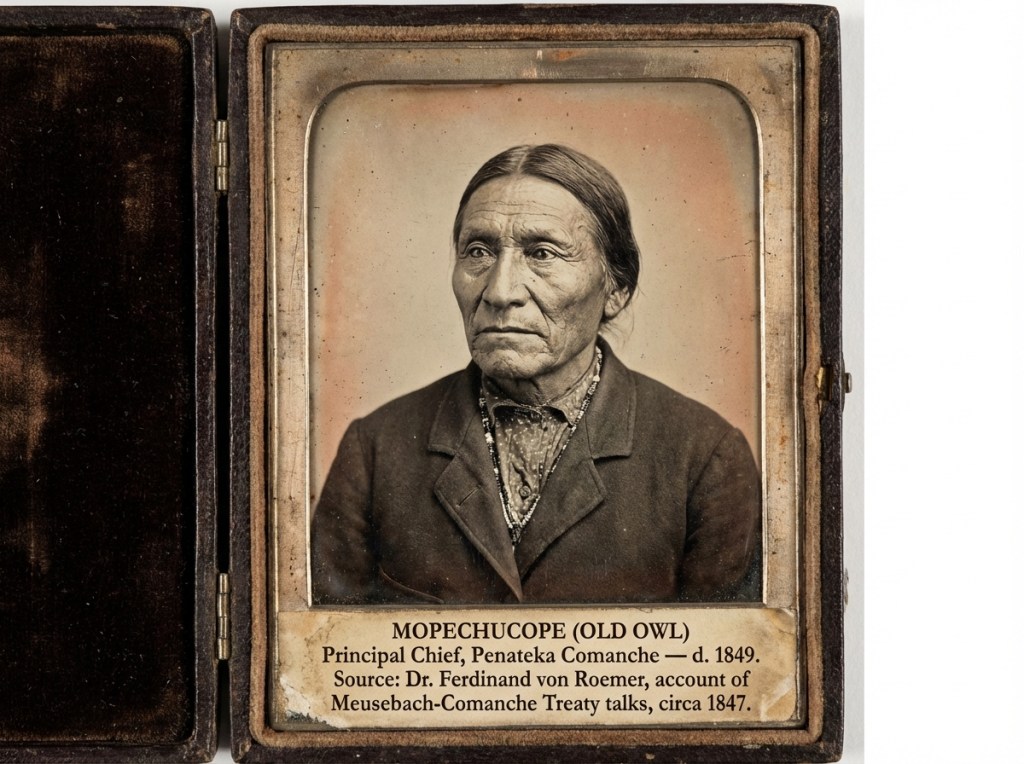
of geologist Dr. Ferdinand von Roemer,
who observed Mopechucope at the
Meusebach-Comanche Treaty talks circa 1847
and described him as a “small, older man”
with a “smart and clever face” wearing
a simple cotton jacket — undistinguished
in appearance, devastating in diplomatic
intelligence. The author of the March 1844
letter to Sam Houston specifying the exact
boundary of Comanche Country. No confirmed
contemporary image exists. This portrait
is an interpretive reconstruction
for exhibition purposes.
MOPECHUCOPE / OLD OWL (d. 1849)
Principal Chief of the Penateka Comanche
Mopechucope — known to Anglo-Texans as Old Owl — was the principal civil chief of the Penateka Comanche in the period following the Council House Fight, and his March 1844 letter to Sam Houston is one of the most remarkable primary source documents in this entire history. Writing from near the head of the Colorado River, Mopechucope addressed Houston as “My Brother” and stated the Comanche position with sovereign clarity: a defined boundary line, running from the Brazos over the Comanche Peak to the San Saba and thence to the Rio Grande, above which “all is Comanche Country and ever has been I my self never have left it nor never intends to” (Texas Indian Papers, 1844–1845 8).
The letter demonstrates the sophistication of Comanche diplomatic intelligence. Mopechucope acknowledged that his people were scattered — many had gone to the Rio Grande for mustangs — and that he could not personally attend the proposed April council. But he committed his authority to the peace process and charged his young men specifically not to interfere with Texans or their property. He noted that since the Treaty with Eldredge, “there has been no mischief done by the Comanche since that time; neither to the Texians or the Tonkawa or Lipan” (Texas Indian Papers, 1844–1845 7). He asked for a prisoner exchange and committed to coming personally to see Houston as soon as his young men returned.
The letter is significant for this project’s argument precisely because it is the document the exceptionalist cultural imaginary has most thoroughly suppressed. It reveals a sovereign political leader conducting international diplomacy on behalf of his nation, specifying territorial claims with geographic precision, and extending good faith toward a republic that had — through the Council House Fight, the Moore expedition, and the uninterrupted operation of its colonization apparatus — demonstrated structural bad faith. Hämäläinen records that the Comanche had “declined in early 1843 an invitation to talks by declaring that ‘the bones of their brothers that had been massacred at San Antonio had appeared on the Road and obstructed their passage’” (Hämäläinen 217) — a formulation that reveals the depth of the wound the Council House Fight had opened. That Mopechucope was willing, by March 1844, to reopen diplomatic communication is testimony to the political intelligence and strategic persistence of Comanche leadership. His mark (as Mo-pe-chu-co-pe, Chief) appears on the Treaty of Tehuacana Creek (Texas Indian Papers, 1844–1845 117–118). He died in 1849, before the full weight of U.S. annexation had fallen on Comancheria.
Sources
Texas Indian Papers, 1844–1845, ed. Winfrey and Day (Texas State Library, 1960), pp. 6–8, 117–118; Hämäläinen, The Comanche Empire (Yale UP, 2008), pp. 217–218.
 PROJECTPLUM WOKE#