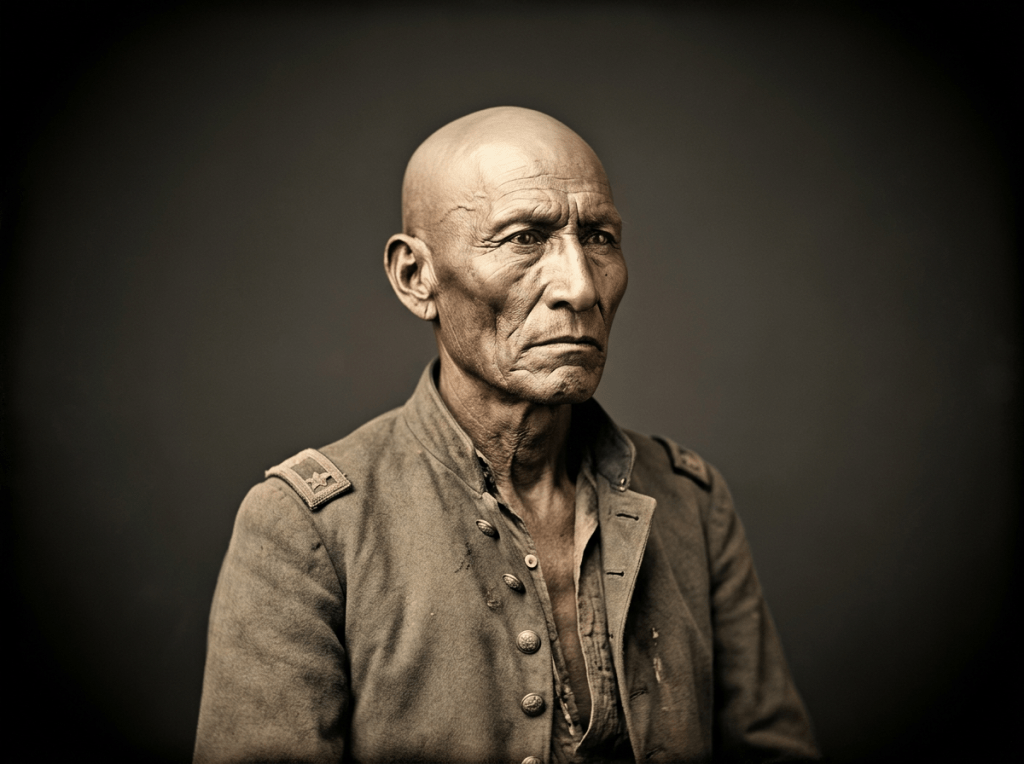
account of Noah Smithwick, who knew Muguara
personally and described him as elderly,
tall, and “wiry thin” with the notable
distinction of baldness — rare among the
Comanche — and often seen wearing the
remnants of a soldier’s uniform. Smithwick
called him “my old friend” and recorded
that Muguara chose certain death over
the disgrace of captivity on March 19, 1840.
No confirmed contemporary image exists.
This portrait is an interpretive reconstruction
for exhibition purposes.
MUGUARA (MUKE-WAR-RAH) (d. 1840)
Principal Chief of the Penateka Comanche
Muguara — known to Anglo-Texans as Muke-war-rah — was one of the most prominent chiefs of the eastern Penateka Comanche bands and one of the twelve chiefs who died in the Council House Fight of March 19, 1840. He appears in the Texas Indian Papers as a signatory of the 1838 Treaty of Peace and Amity between Texas and the Comanche, negotiated in Houston by Commissioners R. A. Irion and Ashbel Smith — indicating that he had been a diplomatic interlocutor with the Republic since its earliest years.
Muguara’s presence at the Council House on March 19, 1840 was therefore not that of a hostile warrior but of a chief with an established diplomatic relationship with the Republic — a relationship the Republic chose to exploit rather than honor. Noah Smithwick, who had dealt with Muguara personally over many years, referred to him as “my old friend Muguara, true to their character, sprang to arms, preferring certain death to the disgrace of captivity under any circumstances” (Smithwick 249–250). Smithwick’s characterization — admiring even within its settler-Texan frame — reveals the political and personal stature Muguara carried.
Pekka Hämäläinen records that in January 1840, after the Penateka had been devastated by a smallpox epidemic, Comanche chiefs sent representatives to San Antonio to discuss peace — returning a white boy and explaining that their nation had “rejected the offers of the [Mexican] Centralists, who have emissaries among them, striving to stir up a general revolt” (Hämäläinen 216). Muguara led sixty-five men, women, and children to San Antonio in March 1840 in good faith pursuit of these diplomatic overtures. When Colonel Fisher informed the assembled chiefs they would be held as hostages until captives were produced, Muguara’s response — resistance unto death rather than submission to captivity — was understood by contemporaries on both sides as an assertion of dignity consistent with his standing as a sovereign leader. His death, and the deaths of the eleven other chiefs who died with him, constituted what this project terms the political decapitation of the eastern Comanche bands, removing the leadership structure that had been conducting diplomacy with the Republic for two years.
Sources
Texas Indian Papers, 1825–1843, ed. Pickrell and Temple (Texas State Library, 1959), pp. 50–53; Brice, The Great Comanche Raid of 1840 (1968), pp. 34–40; Smithwick, Evolution of a State (Gammel, 1900), pp. 249–250; Hämäläinen, The Comanche Empire (Yale UP, 2008), p. 216.
 PROJECTPLUM WOKE#