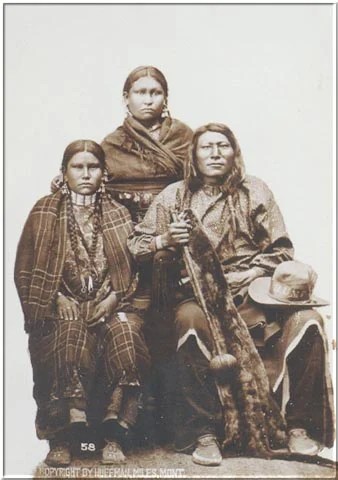
POTSANAQUAHIP / BUFFALO HUMP (c. 1800–c. 1867)
War Chief of the Penateka Comanche
Potsanaquahip — known to Anglo-Texans as Buffalo Hump — was the war chief who led the Great Comanche Raid of August 1840 and who appeared as the principal Comanche delegate at the Treaty of Tehuacana Creek in October 1844. He represents, across the arc of this history, both the fullest expression of Comanche sovereign military power and its gradual structural containment.
In August 1840, commanding a force estimated variously at five hundred to one thousand warriors (possibly augmented with Kiowa allies and, according to some sources, armed with guns from Bent’s Fort), Potsanaquahip led a coordinated military expedition that struck Victoria on August 6, destroyed Linnville on August 8, and began a fighting withdrawal northward that culminated in the Battle of Plum Creek on August 12. The scope of the operation — reaching the coast of the Gulf of Mexico, penetrating hundreds of miles into the Republic’s settled zone, and returning laden with several thousand horses and mules — was, as this project argues, a demonstration of sovereign military power and a political response to the Council House massacre, not an unprovoked raid. Hämäläinen places Potsanaquahip within the broader strategic context of Comanche resistance to Texan expansion, noting that his forces were “possibly armed with guns obtained from Bent’s Fort” — suggesting a sophisticated engagement with the region’s geopolitical networks (Hämäläinen 216).
Four years later, at the councils leading to the Treaty of Tehuacana Creek, Potsanaquahip appeared as the principal Comanche diplomatic voice — demanding, according to Hämäläinen, a boundary line running from the southern tip of the Cross Timbers, a “good days ride” above Austin, then southwestward skirting San Antonio and following the San Antonio Road to the Rio Grande (Hämäläinen 218). His demand was maximalist and deliberate — a negotiating position asserting Comanche claims to the overwhelming majority of Texas — and though Houston found it politically impossible to concede, it forced the treaty’s final language to defer the boundary question into the future tense. Potsanaquahip’s mark (as Po-cha-na-quar-hip, War Chief) appears on the treaty’s signature page (Texas Indian Papers, 1844–1845 117). He continued to resist U.S. expansion after Texas annexation, leading raids into Texas in the 1840s and 1850s before his band was eventually confined to a reservation. He died around 1867.
Sources
Hämäläinen, The Comanche Empire (Yale UP, 2008), pp. 216–218; Texas Indian Papers, 1844–1845, ed. Winfrey and Day (Texas State Library, 1960), pp. 114–119; Brice, The Great Comanche Raid of 1840 (1968); Smithwick, Evolution of a State (Gammel, 1900); Wilbarger, Indian Depredations in Texas (Hutchings, 1889).
 PROJECTPLUM WOKE#