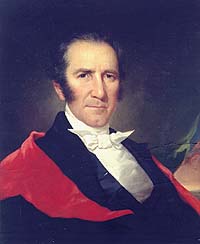
SAM HOUSTON (1793–1863)
President of the Republic of Texas (1836–1838; 1841–1844)
Samuel Houston was born in Rockbridge County, Virginia, and spent formative years living among the Cherokee nation in Tennessee — an experience that gave him an unusually intimate understanding of Indigenous political life rare among Anglo-American political leaders of his era. He served as Governor of Tennessee before arriving in Texas in 1833, where he became the commanding general of the Texan forces at the Battle of San Jacinto (1836), securing Texas independence from Mexico. He was subsequently elected the first President of the Republic of Texas.
Houston’s approach to Indigenous relations stood in structural contrast to his successor Lamar, though as this project’s analysis demonstrates, both served the same territorial imperative through different tactical means. Houston pursued diplomacy and treaty-making, believing that a stable republic required negotiated peace with Indigenous nations. He negotiated the 1836 treaty with the Cherokee under Chief Bowles and dispatched commissioners to the Comanche in 1838. His veto message to Congress in June 1837 warned against the looseness of the land office legislation that was generating speculative fraud — a rare moment in which the state’s own executive acknowledged the convergence of private land hunger and public territorial ambition that Wolfe calls the rabble-state convergence.
Returning to the presidency in 1841 after Lamar’s disastrous campaigns had drained the Republic’s treasury, Houston attempted to restore diplomatic relations with the Comanche, establishing government-sponsored trading houses and sending peace feelers into Comancheria. He participated personally in the councils at the Falls of the Brazos and at Tehuacana Creek in October 1844, addressing assembled chiefs with the language of brotherhood: “Send word soon that peace has been made from the Red River to the Rio Grande” (Texas Indian Papers, 1844–1845 114). Yet Houston’s diplomatic preference was structurally constrained: Texas law did not recognize Indigenous land titles, and the colonization contracts he himself defended — as when he vetoed the repeal of empresario legislation, arguing that “the contractors for the settlement of our vacant domain have not yet had time to perfect their respective contracts” (Public Land System 46) — continued to operate against the same Comanche sovereignty he claimed to respect. His role in this history is that of a man whose personal sympathies were genuine and whose structural function was identical to those who harbored none.
Houston later served as U.S. Senator from Texas (1846–1859) and as Governor of Texas (1859–1861), from which office he was removed after refusing to take the oath of loyalty to the Confederacy.
Sources
Texas Indian Papers, 1844–1845, ed. Winfrey and Day (Texas State Library, 1960); McKitrick, The Public Land System of Texas, 1823–1910 (1918); Writings of Sam Houston, 1837, Vol. 2; Hämäläinen, The Comanche Empire (Yale UP, 2008); Brice, The Great Comanche Raid of 1840 (1968).
 PROJECTPLUM WOKE#