Sam Houston Address to Congress
-
Sam Houston to the Congress
1841
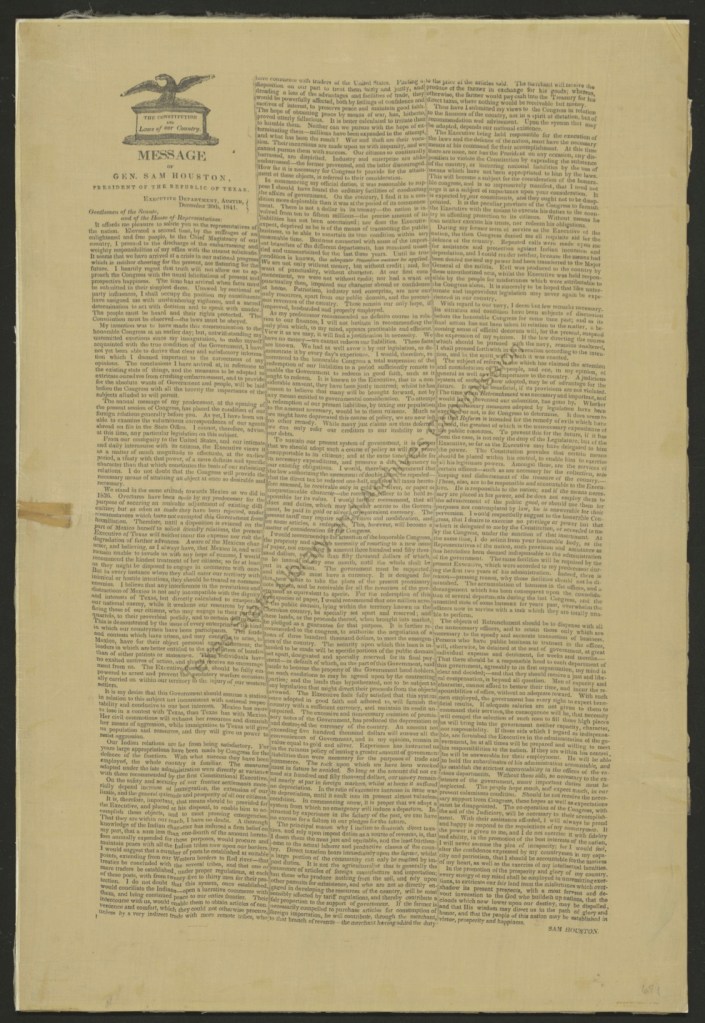
Sam Houston’s 1841 address to Congress marks a clear shift in the direction of frontier policy within the Republic of Texas. Where earlier policy—most clearly articulated in Lamar’s 1839 address—emphasized protection, enforcement, and expansion, Houston reintroduces a different framework: one grounded in diplomacy, reduced expenditure, and the possibility of sustained relations with Indigenous groups.
Central to this shift is Houston’s argument regarding cost. He proposes that a policy of peace can be maintained at a fraction—approximately one quarter—of the financial burden associated with Lamar’s frontier strategy. In doing so, Houston reframes the question of Indigenous relations not only as a matter of principle, but as one of governance and sustainability. Policy is measured not only by its outcomes, but by the resources it requires.
Yet this moment of reversal must be read within the broader structure traced by the project. By 1841, the Republic’s land system is already firmly in place. Legislative acts, land grants, and colonization contracts have extended settlement across large portions of the territory. The administrative and legal mechanisms that organize land—survey, registration, allocation—continue to operate regardless of shifts in policy at the executive level.
Houston’s address therefore does not undo the structures established in the preceding years. Instead, it proposes a different way of managing their consequences. Peace becomes a strategy within an existing system, rather than an alternative to it. Diplomacy is not positioned outside expansion, but alongside it.
This distinction is critical. The contrast between Lamar and Houston is often framed as a simple opposition—war versus peace. The archive complicates this view. Both approaches operate within the same underlying framework of territorial organization. What differs is the method by which relations at the frontier are handled: coercion in one case, negotiation in the other.
Placed alongside the Cherokee Treaty of 1836 and the Tehuacana Creek Treaty of 1843, Houston’s address forms part of a recurring pattern. Moments of negotiation emerge within a system otherwise structured by expansion. These moments do not replace that system; they coexist with it.
The address thus reveals a key feature of the historical process examined in this project: policy may shift, but structure persists. The management of the frontier can change in tone and method, yet the underlying organization of land, authority, and settlement remains in place.
Source
Texas State Library and Archives Commission. Republic of Texas Presidential Papers: Sam Houston, 1841 Messages and Correspondence. Archives and Information Services Division.
 PROJECTPLUM WOKE#