Treaty at Tehuacana Creek with the Comanche
-
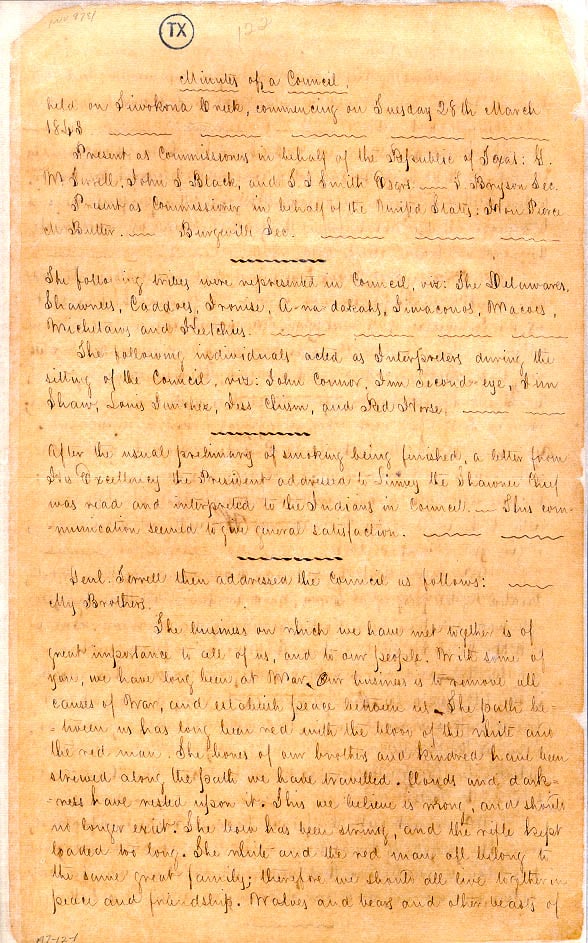
Republic of Texas and Comanche representatives
October 9, 1844
On October 1844, representatives of the Republic of Texas met with Comanche leaders at Tehuacana Creek to negotiate a formal agreement intended to stabilize relations after years of escalating conflict. The treaty followed a period marked by violence, retaliation, and failed diplomacy—including the events that culminated in the Battle of Plum Creek (1840).
The agreement sought to establish peace through defined terms: cessation of hostilities, regulation of trade, and the return or exchange of captives. It also attempted to articulate territorial understandings, though without resolving the central issue that had underpinned earlier conflict—sovereignty over Comanche lands. While the Republic approached the treaty as a mechanism to secure its expanding frontier, Comanche leaders engaged it as part of an ongoing negotiation over presence, movement, and authority across their territory.
The treaty illustrates a recurring pattern in the Republic’s frontier policy: diplomacy followed violence, yet did not fundamentally alter the structural conditions that produced it. Agreements were made, but boundaries remained ambiguous, enforcement uneven, and mutual expectations misaligned. As a result, the treaty functioned less as a final settlement than as a temporary arrangement within a continuing process of territorial contestation.
Placed within the broader sequence of events, the Tehuacana Creek treaty reveals how formal negotiation coexisted with expansionist policy. Even as peace was declared, the underlying pressures—settlement, land grants, and military presence—continued to reshape the region.
Source
Treaty at Tehuacana Creek. October 9, 1844. Republic of Texas treaty records.
Texas State Library and Archives Commission, Archives and Information Services Division, Austin, TX.
 PROJECTPLUM WOKE#